Rich Veal Jus
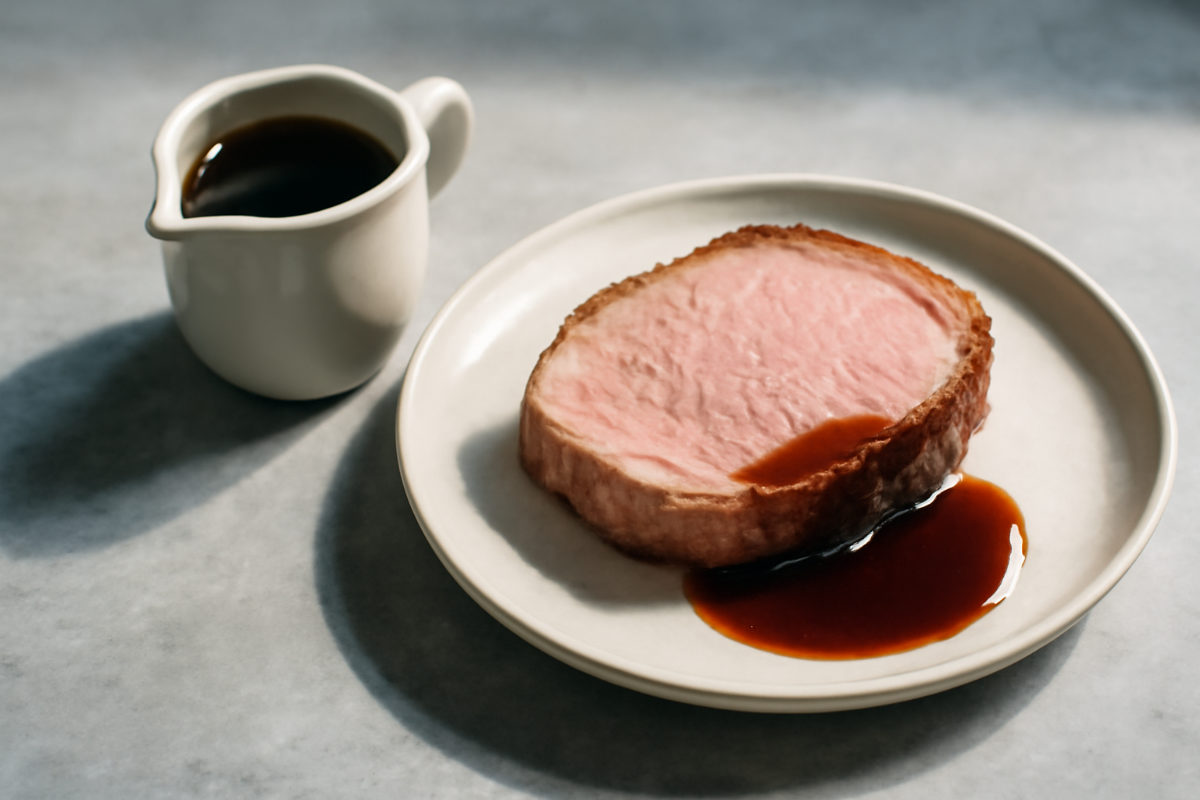
Roasted veal bones reduced to a spoon coating jus with no flour anywhere near it, thickened purely by its own gelatine.
- Contains meat
- Gluten free
- Dairy free
- veal
- jus
- gluten free
- reduction
- restaurant technique
- Prep
- 25 min
- Cook
- 9 hrs
- Total
- 9 hr 25 min
- Serves
- 8
- Difficulty
- Hard
Veal bones are the classical choice for one reason, they are absolutely loaded with collagen and have a mild flavour that lets whatever you serve it with do the talking. This is a pure reduction, no roux, no cornflour. The gloss and the body come from the bones and nothing else, which is why it takes so long.
Ingredients
Makes about 400ml of intense jus, a generous 50ml a plate
Scaled amounts are rounded to something you can actually measure. Season at the end and trust your mouth over the maths.
Kit
- Roasting tin
- Tall stockpot
- Fine sieve
- Muslin
- Wide reduction pan
Method
Heat the oven to 210C fan (230C conventional, gas 8). Oil the veal bones and roast for an hour, turning twice, until they are an even deep golden brown. Veal bones brown more slowly than beef because there is less fat and blood in them, so give them the time.
Add the vegetables and garlic in the last 20 minutes along with the tomato purée, stirring it through so it toasts against the hot tin.
Transfer to a tall stockpot, deglaze the tin with a little water and add that in. Cover with 6 litres of cold water so everything is well submerged, because this simmers a long time and you want room to lose liquid.
Bring up slowly and skim hard for the first 30 minutes. Once clear, add the thyme, bay and white peppercorns and drop to the barest simmer. White peppercorns rather than black keeps the finished jus from looking speckled and gives a cleaner heat.
Simmer for 8 hours, never letting it boil. Top up with hot water only if the bones threaten to break the surface. Veal gives up its gelatine slowly, and this long low cook is exactly where the body comes from.
Strain through a sieve lined with muslin, then chill overnight. Lift off the fat cap. The stock underneath should be set like a firm jelly and jiggle when you knock the container. If it is liquid, you either boiled it or you needed more knuckle.
Pour the jellied stock into a wide pan and reduce at a steady simmer, skimming the edge, until it has gone from around 2.5 litres down to 400ml. Expect 90 minutes to 2 hours. Towards the end it will start to look syrupy and the bubbles get slower and larger, so watch it closely.
Test it by dipping a spoon and drawing a line through the back. If the line holds without running, you are there. Add the sherry vinegar, season with a little flaky salt and serve straight away, spooned rather than poured.
Tips worth knowing
- A jus this concentrated is a spoonful per plate, not a boatful. Serve it in a small jug and let people help themselves.
- The last 15 minutes of reduction is where a jus goes from perfect to burnt sugar. Turn the heat down as it thickens and stir round the base of the pan.
- That teaspoon of vinegar at the end is not optional. Long reductions go flat and slightly sweet, and a sharp note snaps everything back into focus.
- Veal bones can be hard to find in supermarkets. Any decent butcher will get them in with a couple of days notice, and they cost very little.
Change it up
- Add 250ml of dry white wine to the pot after skimming for a lighter jus that suits roast chicken or pork, or use white grape juice with a squeeze of lemon for a non-alcoholic version.
- Reduce a little further and whisk in 30g of cold diced butter off the heat for a jus gras with a heavier, glossier finish.
- Steep a few dried morels in the reducing jus for the last 20 minutes, then strain, for a mushroom scented version for beef.
Keeping and reheating
The jus keeps ten days in the fridge because it is so concentrated, and freezes for six months. Reheat gently in a pan and never let it boil again once reduced.
Questions people ask
Why use veal bones instead of beef bones?
Veal bones from a young animal are far richer in collagen and much milder in flavour. That means the jus sets to a firm jelly and gains real body without tasting overwhelmingly of beef, so it works under fish, poultry and pork as well as red meat.
How do I know when a jus is reduced enough?
Dip a spoon, turn it over and draw a finger through the coating on the back. If the line stays clean and the jus does not run back over it, you have reached nappe. If in doubt, chill a teaspoon on a saucer for a minute and see how it sets.
Is jus the same as gravy?
They overlap. Jus is thickened only by reduction and gelatine, so it is thinner, glossier and much more intense. Gravy usually carries flour or cornflour, is served in larger quantity and is meant to be poured. Both belong on a roast, just in different amounts.