Beef Demi-Glace Gravy
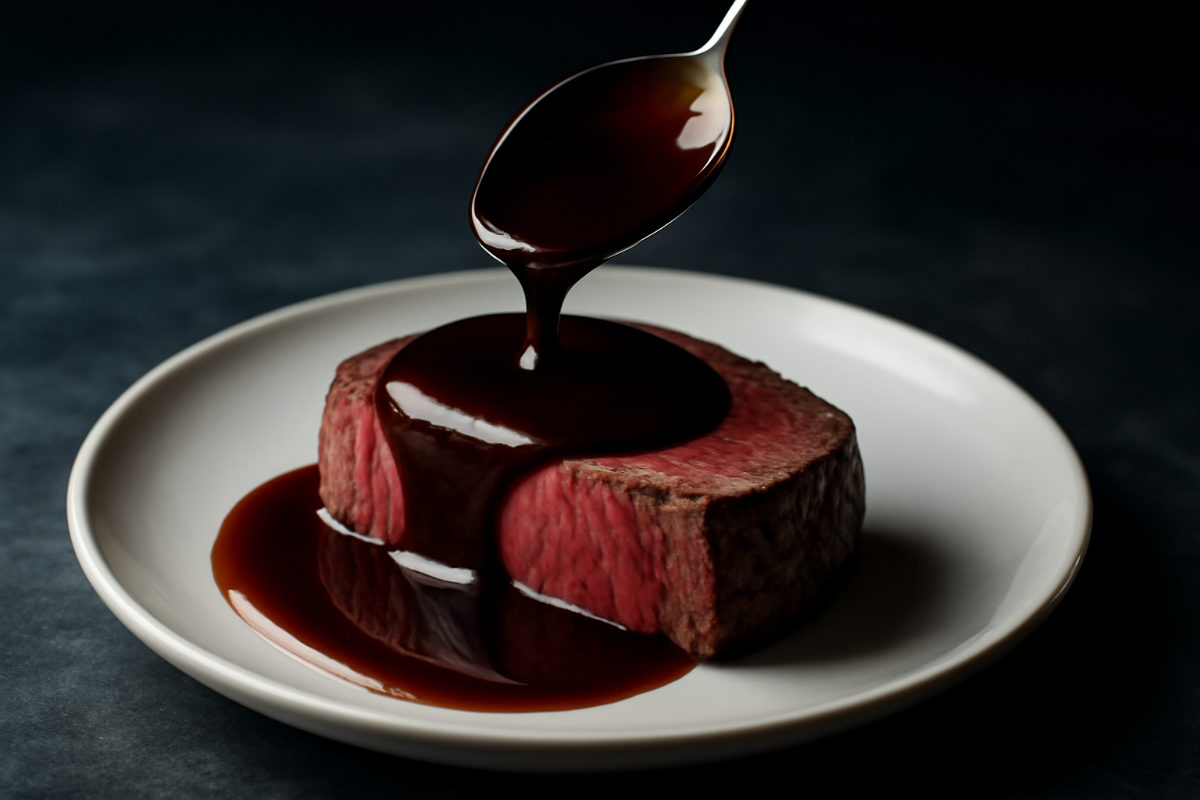
Equal parts espagnole and brown stock, reduced by half, until you have the thick glossy sauce that classical cooking is built on.
- Contains meat
- demi-glace
- classical
- beef
- reduction
- restaurant technique
- Prep
- 20 min
- Cook
- 5 hrs
- Total
- 5 hr 20 min
- Serves
- 10
- Difficulty
- Hard
Demi-glace gets thrown around loosely on menus, but it means one specific thing: espagnole sauce and brown stock in equal measure, reduced by half and strained. It takes a day and it is the most useful thing you can have in the freezer. A tablespoon of it will rescue almost any gravy.
Ingredients
Makes about 750ml, and a little goes a long way
Scaled amounts are rounded to something you can actually measure. Season at the end and trust your mouth over the maths.
Kit
- Heavy based saucepan
- Wide sauté pan
- Fine sieve
- Ladle
Method
If you are making the espagnole fresh, melt the 60g of butter in a heavy pan and stir in the flour. Cook it over medium low heat for 12 to 15 minutes, stirring often, until the roux is the colour of an old penny and smells like toasted hazelnuts. This is a brown roux and it takes patience, but rushing it on high heat gives you burnt specks and no thickening power.
Stir the diced vegetables into the roux and cook for 5 minutes, then add the tomato purée and cook another 2 minutes. Whisk in 1 litre of the brown stock a ladle at a time, keeping it smooth, then add the bay and thyme and simmer very gently for an hour, skimming the skin that forms at the edge. Strain, and that is your espagnole.
Pour the espagnole and the second litre of brown stock into a wide pan. Wide matters, because reduction happens at the surface and a tall narrow pan will take twice as long.
Bring to a gentle simmer and hold it there. Do not boil it hard, because a hard boil forces the fat back into the sauce and it will never look glossy.
Reduce by half over 2 to 3 hours, which sounds vague until you mark the level with a wooden skewer at the start. Skim the fat and skin off the side of the pan every 20 minutes. Classical kitchens call this depouillage, and it is the whole reason a good demi-glace tastes clean rather than heavy.
You are done when the sauce coats the back of a spoon and holds a clean line when you draw a finger through it. It should be roughly the thickness of single cream while hot, because it thickens further as it cools.
Strain through a fine sieve into a clean pan. Taste and season with salt, then whisk in the cold butter off the heat for shine.
To serve as gravy, thin about 250ml of demi-glace with 100ml of hot stock or the juices from whatever you have roasted. Neat demi-glace is too intense to pour over a plate.
Tips worth knowing
- Mark your starting level on a wooden skewer or the handle of a spoon. Guessing at half is how people end up with a sauce that is either thin or gluey.
- Skim from one side. Pull the pan slightly off centre on the burner so the convection pushes all the fat and skin to the cool edge where you can lift it off in one go.
- Freeze demi-glace in an ice cube tray. One cube dropped into a pan gravy turns an average one into a proper one.
- If it sets solid in the fridge, that is correct. It should be a firm wobbly block, not a liquid.
Change it up
- Add 150ml of red wine to the reduction at the start for a sauce closer to a bordelaise base, or a spoon of pomegranate molasses let down with water if you are avoiding alcohol.
- Reduce it a further half again to make glace de viande, a syrupy meat glaze that keeps for weeks and dissolves into anything.
- Finish a portion with crushed green peppercorns and a spoon of cream for a steak sauce.
Keeping and reheating
Keeps a week in the fridge as a set block and six months in the freezer. Reheat gently with a splash of stock, never in the microwave on full power or it will separate.
Questions people ask
What actually is demi-glace?
It is equal quantities of espagnole sauce and brown stock, simmered together until reduced by half and then strained. That is the classical definition. Anything sold as demi-glace that is just reduced stock is really a glace or a jus, which is fine but not the same thing.
Can I make demi-glace without flour?
Not strictly, because the espagnole half is thickened with a brown roux by definition. You can make a modern flourless version by reducing brown stock until it naps a spoon, and it is excellent, but call it a jus lié rather than demi-glace.
Why does my demi-glace taste bitter?
Either the roux went past brown into burnt, or the bones for the stock were roasted too dark. Both are irreversible. Aim for a roux the colour of an old penny and bones the colour of strong tea, and stop there.