Japanese Curry Sauce
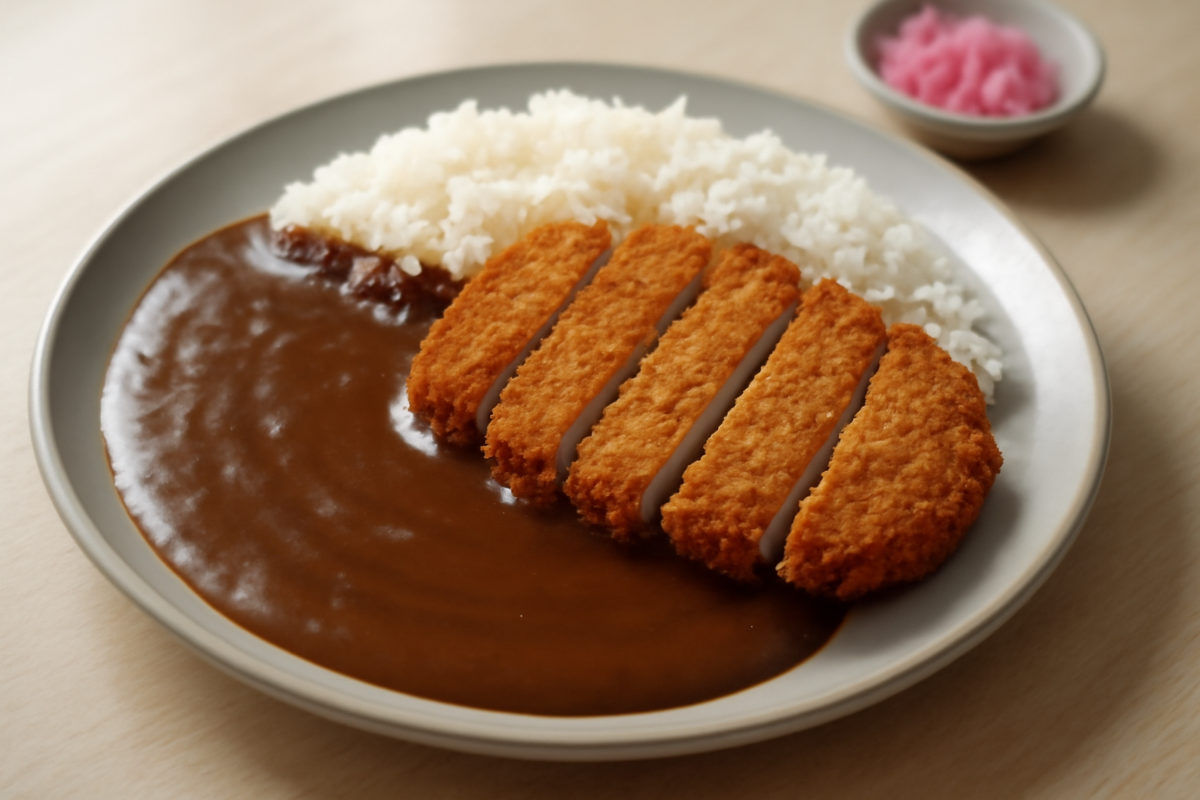
Kare, the mild sweet brown curry sauce of Japanese home cooking, built from a slowly browned butter and curry powder roux with grated apple and onion for body.
- Contains meat
- japanese
- curry
- roux
- katsu
- Prep
- 15 min
- Cook
- 40 min
- Total
- 55 min
- Serves
- 4
- Difficulty
- Medium
Japanese curry, kare, arrived by way of the British Royal Navy in the nineteenth century and turned into something entirely its own: thick, dark, mildly spiced and faintly sweet. Most Japanese households make it from a block of solid roux out of a packet and there is nothing wrong with that. This is the from scratch version, which takes about forty minutes and lets you decide how sweet and how hot it ends up.
Ingredients
Makes about 700ml, enough for four plates of rice
Scaled amounts are rounded to something you can actually measure. Season at the end and trust your mouth over the maths.
Kit
- Heavy based saucepan
- Small frying pan
- Box grater
- Whisk
- Sieve
Method
Heat the oil in a heavy saucepan over a medium low heat and add the onions with a good pinch of salt. Cook them for twenty to twenty five minutes, stirring every few minutes, until they have collapsed to a soft golden brown tangle. This is the single biggest source of sweetness in the sauce, so do not rush it.
Stir in the garlic, ginger and grated apple and cook for another three minutes until the apple has softened and the raw garlic smell has gone.
Pour in the hot stock, bring to a simmer and cook uncovered for ten minutes. Take it off the heat.
While that simmers, make the roux. Melt the butter in a small frying pan over a low heat, whisk in the flour and cook it gently for six to eight minutes, stirring constantly, until it is the colour of milky coffee and smells like biscuits. Low and slow is the point. A pale roux gives you a pale, floury tasting curry.
Take the roux off the heat, stir in the curry powder and garam masala and let them sizzle in the residual heat for thirty seconds. Adding the spices off the heat stops them catching and turning bitter.
Whisk the roux into the hot stock and onions a spoonful at a time. It will thicken quickly and look lumpy at first, so keep whisking until it is smooth.
Add the tomato puree, Worcestershire sauce, soy sauce and honey. Simmer very gently for ten minutes, stirring often as it will catch on the bottom once it thickens. It should coat a spoon thickly and drop off in one heavy blob.
Taste and adjust: more soy for salt, more honey for sweetness, a pinch more curry powder for heat. For the classic glossy restaurant texture, push it through a sieve. Serve over rice with a breaded pork or chicken katsu.
Tips worth knowing
- Shop bought curry roux blocks such as S and B Golden Curry or House Vermont Curry are a completely legitimate route and what most Japanese cooks actually use. Simmer your onions, apple and stock as above, take the pan off the heat, then dissolve two or three squares of the block in and simmer for five minutes. You will find them in Japanese and Chinese supermarkets, Oriental Mart online and the world food aisle of larger Tesco and Sainsbury's branches.
- Japanese curry powder is milder and more fragrant than a madras, but a standard British curry powder is genuinely close, since that is where the dish came from in the first place.
- If it thickens more than you want, loosen it with hot stock rather than water so you do not dilute the flavour.
- Grated apple is not optional in the way it looks. It gives the sauce its particular round sweetness, and honey alone does not do the same job.
Change it up
- Add a tablespoon of grated dark chocolate and a teaspoon of instant coffee with the tomato puree for the darker, richer style some Japanese cafes serve.
- For a vegan version use vegetable stock, swap the butter for the same weight of coconut oil, use vegan Worcestershire sauce and sweeten with maple syrup.
- Stir in 200g of diced potato and carrot with the stock and simmer until tender for a full curry rather than a pouring sauce.
Keeping and reheating
Keeps five days in the fridge and freezes well for three months. It sets solid when cold, which is normal. Reheat gently with a splash of stock, stirring, and never let it boil hard or the roux can split.
Questions people ask
What is the difference between Japanese curry and katsu curry?
They are the same sauce. Katsu just refers to what it is poured over, which is a panko breaded pork or chicken cutlet. The sauce on your katsu curry at a high street chain is standard Japanese curry sauce.
Why is my Japanese curry sauce not dark enough?
Two usual reasons. The onions were not browned for long enough, or the roux was pulled off while still blonde. Both take longer than you think. A spoonful of tomato puree and a splash of Worcestershire sauce also push the colour along.
Can I make Japanese curry sauce without curry roux blocks?
Yes, that is exactly what this recipe does. A butter and flour roux browned slowly, then curry powder and garam masala stirred in off the heat, gives you the same thickness and a fresher spice flavour than the blocks.