Dutch Jus for Roast Beef
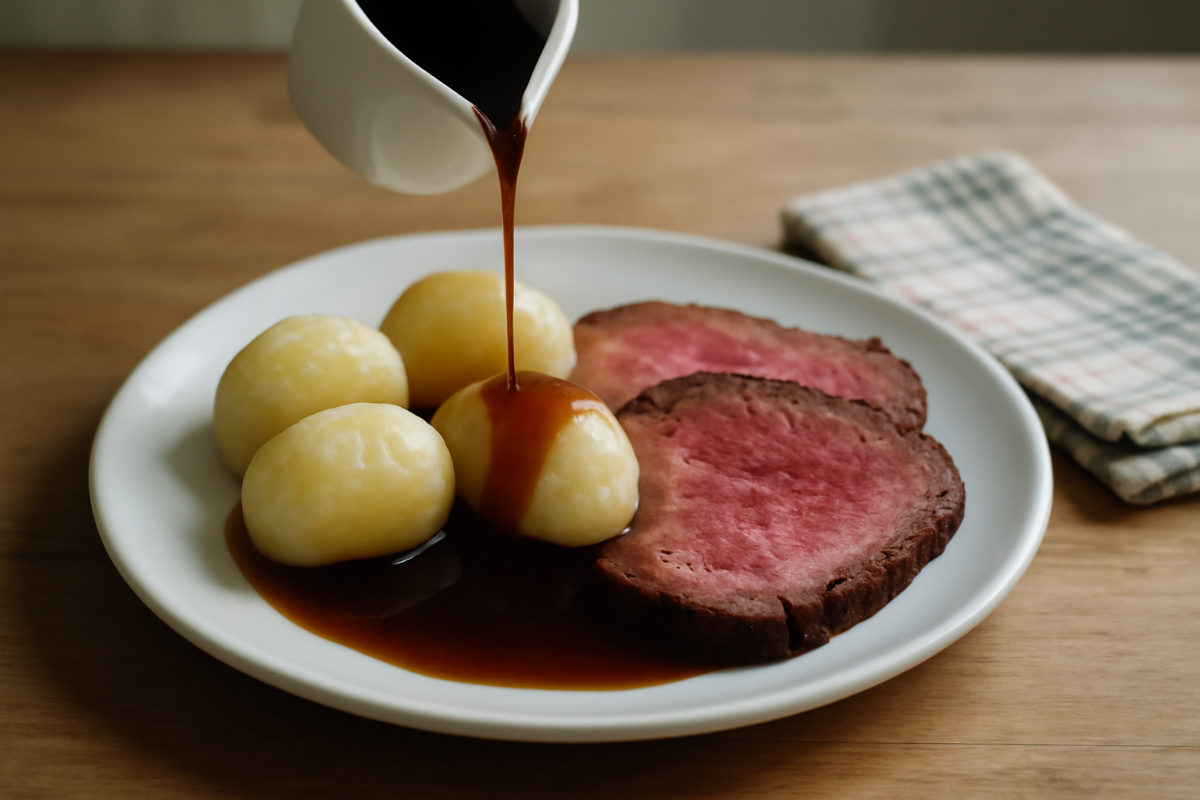
Braadjus, the thin buttery roasting juices Dutch cooks serve with rosbief, deliberately unthickened and poured straight over the potatoes.
- Contains meat
- Gluten free
- dutch
- beef
- jus
- unthickened
- Prep
- 5 min
- Cook
- 12 min
- Total
- 17 min
- Serves
- 6
- Difficulty
- Easy
Dutch jus is not a gravy in the British sense and it is worth saying so plainly. There is no roux, no thickener and no attempt at coating anything. It is the butter and meat juices from the pan, let down with a little water or stock and seasoned properly, and it is poured over boiled or mashed potatoes so it soaks straight in. Made well it tastes intensely of the roast itself.
Ingredients
Makes about 350ml, enough for six
Scaled amounts are rounded to something you can actually measure. Season at the end and trust your mouth over the maths.
Kit
- Roasting tin or heavy frying pan
- Wooden spoon
- Small jug
Method
Lift the beef out of the tin and rest it somewhere warm. Do not pour anything away. In a Dutch roast the fat is mostly butter and it is part of the sauce, not something to be skimmed off.
Set the tin over a medium heat. If it looks dry, add the extra 30g of butter. Add the onion quarters and bay leaf and cook for three or four minutes, pressing the onion down so it picks up colour from the base.
Pour in the hot water or stock and scrape the tin hard with a wooden spoon until every bit of the caramelised residue has lifted and the liquid has turned brown.
Simmer briskly for six or seven minutes, until it has reduced by roughly a quarter and tastes properly of beef rather than of hot water. It will still be thin. That is the whole idea.
Add the vinegar and sugar. These are not there to make it sweet or sour, they just stop a thin sauce tasting flat.
Strain into a warm jug, pressing the onion lightly. Any juices that have run out of the resting beef go in at this point too.
Whisk in the cold butter off the heat, which gives it a faint gloss and a little more body without thickening it. Season hard with salt and black pepper, then pour it over boiled potatoes, mash or stamppot.
Tips worth knowing
- Season this more aggressively than you would a thick gravy. There is nothing much to carry the salt, so an underseasoned jus just tastes watery.
- Water rather than stock is genuinely the traditional choice, and it lets the roasting residue do the talking. Use a light stock only if the pan was not very brown.
- Never boil it hard after the butter goes in, since the sheen is the only thickness this sauce has and boiling breaks it.
- If you want something closer to a British gravy from the same base, whisk in a teaspoon of cornflour slaked in cold water at the simmering stage, though you are then making something else.
Change it up
- Add a tablespoon of ketjap manis, the sweet thick Indonesian soy sauce found in most supermarkets and Asian shops, for the Indonesian influenced version many Dutch households make.
- Simmer a few juniper berries and a strip of orange peel in the jus and strain them out, which suits venison or a rolled beef joint.
- Add 2 tbsp of jenever or dry sherry with the water and boil it off for a more aromatic sauce, or leave it out if you would rather not use alcohol.
Keeping and reheating
Keeps three days in the fridge, where it will set to a soft jelly if your roast was gelatinous. Reheat gently and whisk in a fresh knob of butter. It freezes for three months but loses a little of its fresh roasted character.
Questions people ask
Why is Dutch jus not thickened?
Because it is served over potatoes rather than alongside them. A thin liquid soaks into boiled potatoes, mash or stamppot in a way a thick gravy will not. Some Dutch cooks do use a shop bought thickener called juspoeder, but the classic braadjus is thin.
What is juspoeder?
A Dutch supermarket powder that thickens and seasons pan juices in one go, made by brands like Honig and Maggi. It is convenient and widely used, but it also flattens the flavour of a good roasting pan, which is why it is worth learning to do without.
Can I make Dutch jus without a roast?
Not really, and that is the honest answer. The whole sauce is the roasting residue. If you have no pan to deglaze, you are better off making a proper stock based gravy instead of trying to fake this one.