Italian Sunday Sugo
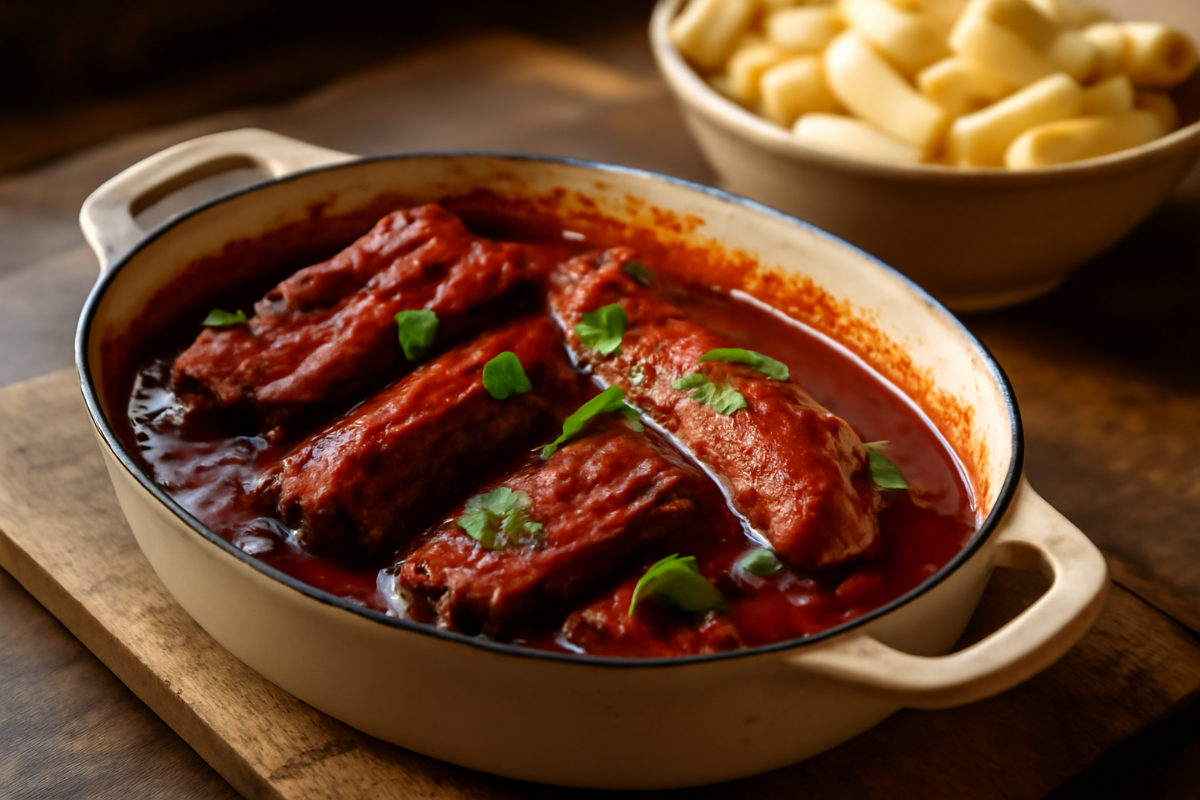
A long simmered tomato and meat sauce with pork ribs, beef and sausage, cooked for three hours until the meat falls apart and the sauce turns dark red.
- Contains meat
- italian
- tomato
- slow cooked
- pasta
- Prep
- 20 min
- Cook
- 3 hrs
- Total
- 3 hr 20 min
- Serves
- 8
- Difficulty
- Medium
This is the sauce Italian American families call Sunday gravy, and it needs saying plainly: it is a meat sauce, not a gravy in the British sense. There is no roux, no stock, no thin pouring liquid. Tomatoes and several cuts of meat go into one pot for three hours and come out as something thick and dark that dresses pasta first and provides the meat course second. That is how it is eaten in a lot of Italian and Italian American homes, and it is worth the afternoon.
Ingredients
Makes about 1.5 litres of sauce plus the meat, enough for eight
Scaled amounts are rounded to something you can actually measure. Season at the end and trust your mouth over the maths.
Kit
- Large heavy casserole
- Wooden spoon
- Tongs
Method
Heat the oil in a large heavy casserole over a medium high heat. Brown the ribs, beef and sausages in batches, about eight minutes a batch, until they have a proper dark crust on at least two sides. Do not crowd the pan or they will steam. Lift each batch onto a plate as it is done.
Turn the heat down to medium low and add the onion, carrot and celery to the fat left behind. Cook this soffritto gently for twelve to fifteen minutes until completely soft and sweet, scraping up the browned residue as it loosens.
Add the garlic for one minute, then the tomato puree. Cook the puree for three or four minutes, stirring, until it turns from bright red to a dark brick colour. This removes its tinny edge and is worth the wait.
Pour in the wine and let it bubble for five minutes, scraping the base, until it has reduced by half and lost its sharp smell.
Add the crushed tomatoes, passata, Parmesan rind, basil stalks and oregano, along with 200ml of water swilled around the tomato tins. Return all the meat and any juices from the plate.
Bring to a simmer, then drop the heat as low as it will go so you get a bubble every few seconds and no more. Cook uncovered, or with the lid ajar, for three hours. Stir every twenty minutes and scrape the bottom, because this sauce will catch and burn if you leave it.
It is ready when the sauce is dark brick red, the oil has risen to the surface in orange pools and the beef falls apart under a spoon. Lift the meat out onto a warm dish and remove the Parmesan rind and basil stalks.
Season the sauce with salt, pepper and a pinch of sugar only if the tomatoes were sharp, then tear in the basil leaves. Toss a little of the sauce through rigatoni or pappardelle as a first course, and serve the meat afterwards with more sauce spooned over.
Tips worth knowing
- The browning at the start is where most of the depth comes from. A pale sauce three hours later almost always traces back to a rushed first ten minutes.
- A low heat and a long time is the point. Boiling it hard for an hour is not the same sauce and the meat will be tough and stringy rather than falling apart.
- Keep Parmesan rinds in the freezer. Dropped into a sauce like this they slowly dissolve and give a savoury depth that grated cheese stirred in at the end does not.
- For a non-alcoholic version, replace the wine with 200ml of beef stock plus 2 tsp of red wine vinegar and reduce it in the same way.
Change it up
- Add braciole, thin beef slices rolled around garlic, parsley and Parmesan and tied with string, browned with the other meats. Very traditional in Italian American households.
- Use lamb shoulder and pork belly instead of beef and ribs for a richer southern Italian version, and add a dried chilli with the tomatoes.
- Leave out the meat entirely and add 400g of mixed mushrooms browned hard at the start, plus a splash of soy sauce, for a vegetarian sugo that still has real depth.
Keeping and reheating
Keeps five days in the fridge and is better on day two. Freezes for six months, meat and all. Reheat slowly with a splash of water, since it thickens considerably as it sits.
Questions people ask
Is Sunday gravy actually gravy?
Not in the British sense. It is a slow cooked tomato and meat sauce, and the word gravy is Italian American usage rather than Italian. In Italy it would be called sugo or ragu. There is no flour, no stock and no thin pouring consistency involved.
What is the difference between sugo and ragu?
The terms overlap and usage varies by region. Broadly, sugo just means sauce and often refers to a tomato sauce cooked with large pieces of meat, while ragu tends to mean a sauce built on chopped or minced meat with less tomato, as in ragu alla bolognese.
Why does my tomato sauce taste sharp?
Underripe or acidic tinned tomatoes, or not cooking the tomato puree out at the start. Cook the puree until it darkens, simmer the sauce longer, and if it is still sharp add a small pinch of sugar or a grated carrot, both of which soften acidity without making it sweet.