Espagnole Sauce, the Mother Gravy
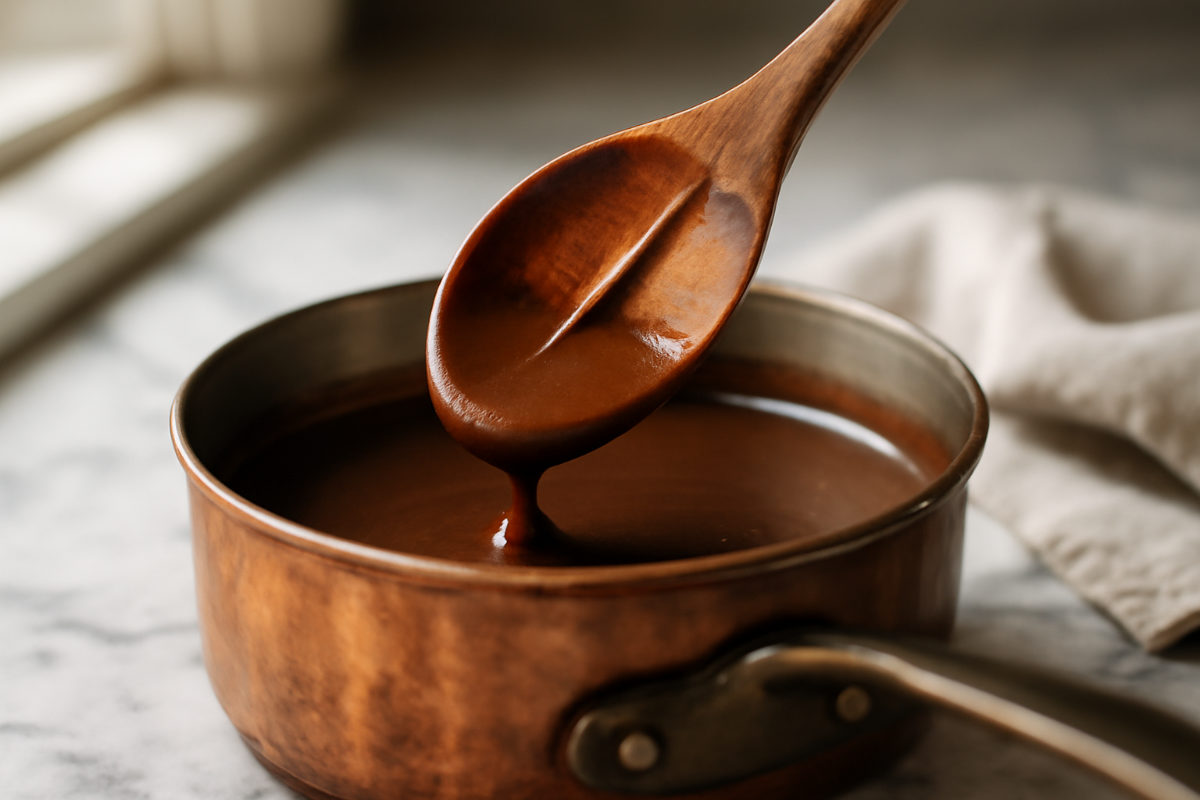
The classical brown mother sauce: a slow cooked brown roux, brown stock, mirepoix and tomato, simmered and skimmed until clean.
- Contains meat
- classical
- mother sauce
- brown roux
- base sauce
- french technique
- Prep
- 20 min
- Cook
- 3 hrs
- Total
- 3 hr 20 min
- Serves
- 8
- Difficulty
- Hard
Espagnole is one of the five French mother sauces and it is essentially the ancestor of every brown gravy in this country. A properly made brown roux, good brown stock and two hours of patient skimming. Make it once and you understand why classical kitchens bothered.
Ingredients
Makes about 800ml of finished sauce
Scaled amounts are rounded to something you can actually measure. Season at the end and trust your mouth over the maths.
Kit
- Heavy based saucepan
- Wooden spoon
- Ladle
- Fine sieve
- Frying pan
Method
Melt the butter in a heavy pan over medium low heat and stir in the flour. Now cook it, stirring almost constantly, for 15 to 20 minutes. It will go from pale to sandy to biscuit to the colour of an old penny, and it will smell of toasted nuts. This is a brown roux and it is entirely about patience. High heat scorches the flour in seconds and there is no recovering it.
While the roux cooks, fry the bacon in a separate pan until the fat runs, then add the diced onion, carrot and celery and cook for 8 minutes until softened and browning at the edges. Stir in the tomato purée and cook 2 minutes more until it darkens.
Tip the vegetable and bacon mixture into the roux and stir together. It will look dry and paste like, which is correct.
Add the hot stock one ladle at a time, whisking each addition smooth before the next. Adding it all at once is how you get lumps. Bear in mind a brown roux has perhaps two thirds the thickening power of a white one, because the browning breaks down the starch, so it will look thin at first.
Bring to a gentle simmer, add the bouquet garni and peppercorns, and cook uncovered for 2 hours. Pull the pan slightly off centre on the burner so the sauce convects to one side and pushes the fat and skin to the cooler edge.
Skim that fat and skin off every 15 minutes. This is depouillage and it is the difference between a clean tasting espagnole and a heavy, floury one. Expect to remove a surprising amount.
The sauce should reduce to around 800ml and coat the back of a spoon lightly. Strain it through a fine sieve, pressing gently on the solids.
Season with salt only now. Use it as it is over roast meat, or take it on to demi-glace by combining it with an equal volume of brown stock and reducing by half.
Tips worth knowing
- Cook the roux over a lower heat than you think you need. Twenty minutes at medium low beats eight minutes at medium every single time.
- Have the stock hot when it goes into the roux. Cold liquid into hot roux sets the starch into lumps before you can whisk them out.
- Skimming from one side of the pan is a real technique, not a flourish. Setting the pan half off the burner makes the fat collect where you can lift it off.
- A brown roux thickens less than a blond one, so if you swap in a paler roux use about a third less flour or you will end up with wallpaper paste.
Change it up
- Leave out the bacon for a cleaner, more neutral espagnole that works under a wider range of dishes.
- Add 100ml of dry Madeira in the last 20 minutes for a richer sauce, or a spoon of sherry vinegar and a pinch of sugar for a non-alcoholic lift.
- Finish a portion with sautéed mushrooms, shallots and parsley to make a quick chasseur.
Keeping and reheating
Keeps five days in the fridge and six months in the freezer. It thickens considerably when cold, so reheat gently with a splash of stock and whisk it back to a pouring consistency.
Questions people ask
What is espagnole sauce used for?
It is a base rather than a finished sauce. On its own it goes over roast meats as a brown gravy, but its real job is to be turned into demi-glace, or flavoured into daughter sauces like chasseur, bordelaise, madère and diable. That is why it is called a mother sauce.
How dark should a brown roux be?
The colour of an old penny, or a shade lighter than milk chocolate. It should smell toasted and nutty, never acrid. If you see black specks, throw it out and start again, because burnt roux will make the whole sauce bitter.
Is espagnole the same as gravy?
It is the ancestor of it. British brown gravy is essentially a simplified espagnole, roux plus brown stock, without the mirepoix, tomato and the long skimmed simmer. Making the full version shows you exactly what those extra steps are for.