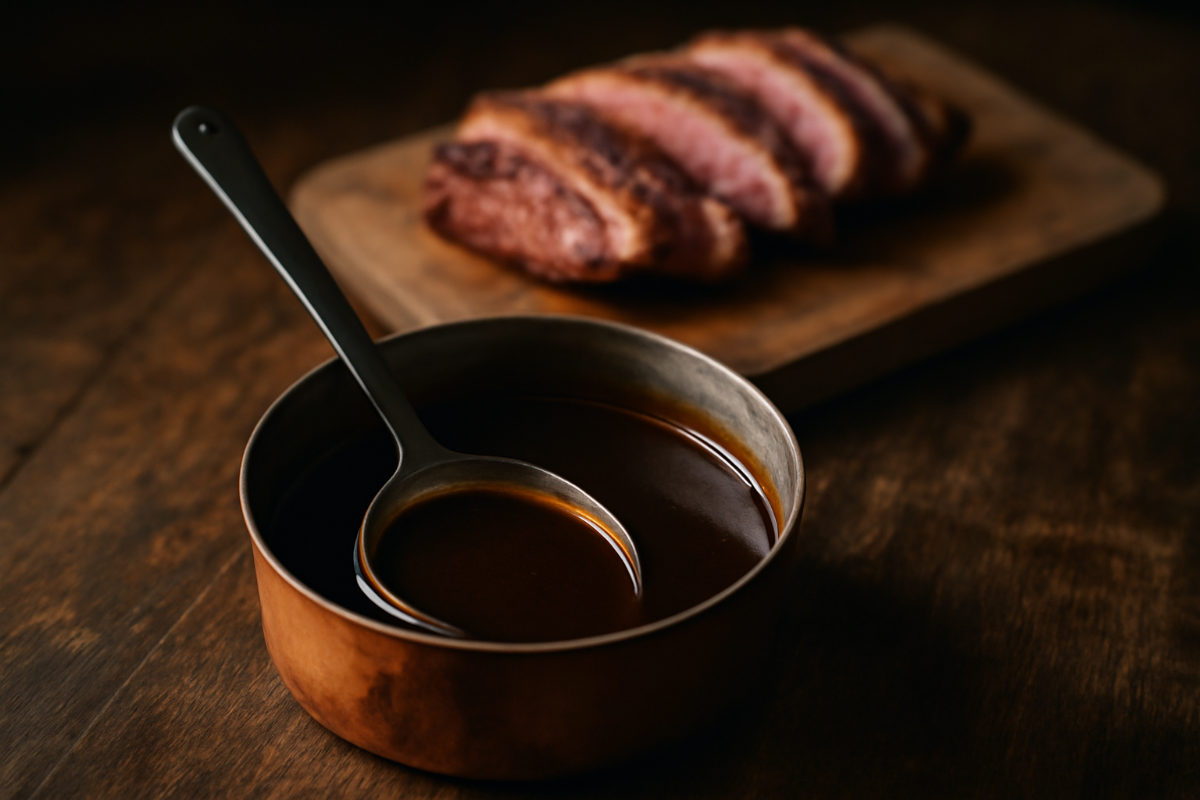
Duck Bone Gravy
Duck carcasses roasted and simmered with thyme and a splash of red wine vinegar, defatted hard because duck throws off a lot of fat.
- Contains meat
- Dairy free
- duck
- bone stock
- duck fat
- dinner party
- rich
- Prep
- 20 min
- Cook
- 4 hrs
- Total
- 4 hr 20 min
- Serves
- 4
- Difficulty
- Medium
Duck makes one of the most flavourful stocks going, but it also renders more fat than anything else in the kitchen. Chill it, take the whole lid of fat off and keep it for roast potatoes, then build the gravy on the clean stock underneath. What is left is dark, savoury and slightly sweet.
Ingredients
Makes about 350ml, enough for four with a duck crown
Scaled amounts are rounded to something you can actually measure. Season at the end and trust your mouth over the maths.
Kit
- Roasting tin
- Saucepan
- Fine sieve
- Jug for defatting
Method
Heat the oven to 210C fan (230C conventional, gas 8). Chop the carcasses up with a heavy knife or kitchen shears so they fit in one layer, and roast dry for 40 minutes. Duck skin renders plenty of fat so there is no need to add any oil.
Pour the rendered fat off into a bowl halfway through, or the bones will fry rather than roast. Add the onion, carrot, celery and garlic for the last 15 minutes.
Move everything to a saucepan. Put the roasting tin over a burner, pour in the red wine and boil it down by half while scraping up the sticky brown residue, then tip that into the pan.
Cover with 2 litres of cold water, bring slowly to a simmer and skim. Add the thyme, bay and peppercorns.
Hold at a bare tremble for 3 hours. Duck bones are small and give up their flavour quickly, and pushing much past this makes the stock taste slightly livery.
Strain and chill for at least four hours. A thick pale cap of duck fat will set on top. Lift it off in one piece and keep it in a jar, because it is the best roast potato fat there is.
Reduce the defatted stock in a wide pan from around 1.2 litres to 450ml, roughly 20 minutes. Taste it at this point and you will see how much the reduction has done.
Heat 2 tablespoons of the reserved duck fat in a pan, stir in the flour and cook to a light brown roux over 3 minutes. Whisk in the hot stock, simmer for 5 minutes, then add the red wine vinegar. Duck is fatty and slightly sweet and it genuinely needs that sharpness. Season and serve hot.
Tips worth knowing
- Pour the fat off partway through roasting. Bones sitting in deep fat do not brown, they confit, and you lose the colour you are after.
- Duck fat is worth more than the gravy in some households. Strain it through muslin and it keeps six months in the fridge.
- Three hours is enough for duck. Longer stocks go slightly bitter and metallic because the bones are so small and thin.
- If you have the duck's liver, do not put it in the stock. Fry it separately and spread it on toast while you wait.
Change it up
- Add a strip of orange peel and a teaspoon of honey to the reduction for a version that leans towards the classic duck à l'orange, or use a splash of unsweetened orange juice if you would rather not use the wine at all.
- Steep six crushed juniper berries in the reducing stock for 15 minutes then strain, which suits wild duck better than farmed.
- Finish with a spoon of cassis and a handful of blackcurrants for a fruit gravy that goes with duck breast.
Keeping and reheating
The stock keeps four days chilled and four months frozen. Finished gravy keeps three days and reheats gently. The rendered fat keeps six months in a sealed jar in the fridge.
Questions people ask
Why is my duck stock so greasy?
Duck simply renders a lot of fat, and the only real fix is chilling. Once cold the fat sets into a firm cap you can lift off whole, which is far more thorough than skimming warm liquid. Never try to build a gravy on a warm, unrested duck stock.
Can I use the carcass after a roast duck dinner?
Yes, and it is the best use for it. Give the picked carcass another 20 minutes in a hot oven to restore the colour, then proceed as normal. One carcass gives about a litre of stock, so halve the water in the recipe.
What can I do with the duck fat left over?
Strain it and keep it. It is the finest fat for roast potatoes, it makes excellent confit, and two tablespoons of it in the roux gives this gravy its character. Keep it in a sealed jar in the fridge and it lasts months.