Vietnamese Star Anise Gravy
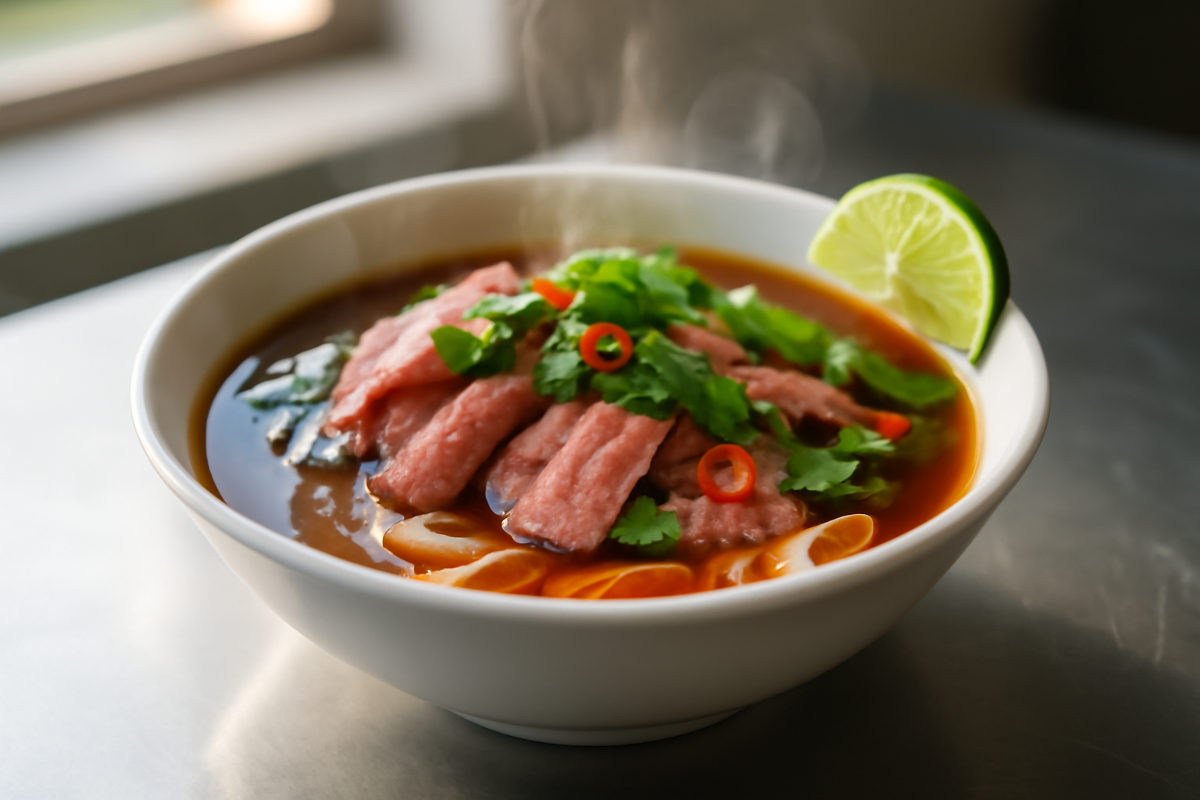
A clear, aromatic beef gravy built on charred onion and ginger with the pho spice set, seasoned with fish sauce and finished with lime and herbs.
- Contains fish
- Dairy free
- Gluten free
- vietnamese
- star anise
- pho
- aromatic
- Prep
- 10 min
- Cook
- 40 min
- Total
- 50 min
- Serves
- 4
- Difficulty
- Medium
This borrows its aromatics from pho broth rather than from any Vietnamese gravy tradition, and it is worth saying that up front. Charring the onion and ginger over a flame, then toasting the whole spices, gives a stock a smoky depth you cannot get any other way. Kept thin and glossy it is superb over rare beef, noodles or a plate of roast potatoes if you are feeling unorthodox.
Ingredients
Makes about 450ml, enough for four
Scaled amounts are rounded to something you can actually measure. Season at the end and trust your mouth over the maths.
Kit
- Dry frying pan or gas hob
- Saucepan
- Fine sieve
- Small bowl
Method
Char the onion and ginger cut side down. Either hold them over a gas flame with tongs for four or five minutes, or press them into a dry hot frying pan until blackened in patches and smelling sweet and smoky. This is the step that gives the sauce its backbone, so let them really blacken rather than just colour.
In the same dry pan over a medium heat, toast the star anise, cinnamon, cloves, coriander seeds and cardamom for about ninety seconds, shaking the pan, until fragrant. Take them off before they smoke.
Put the charred onion and ginger and the toasted spices into a saucepan with the beef stock. Bring to a bare simmer.
Simmer very gently, uncovered, for thirty minutes. Do not let it boil hard, because a rolling boil clouds the stock and makes the spices turn bitter. It should reduce by about a quarter.
Strain through a fine sieve into a clean pan, pressing nothing through. You want it clear. Discard the aromatics.
Add the fish sauce and rock sugar and warm gently until the sugar dissolves. Taste. It should be deeply savoury with the anise sitting behind rather than in front.
Bring it to a simmer, stir the cornflour slurry and pour it in while stirring. Cook for one minute until it turns glossy and just thick enough to coat a spoon. This is meant to stay light, not to become a proper thick gravy.
Off the heat, add the lime juice. Serve poured over thinly sliced rare beef or noodles, with the herbs, chilli and lime wedges on top so people can adjust their own bowl.
Tips worth knowing
- Char, do not just brown. Proper black patches on the onion and ginger are what make this taste like pho rather than like beef stock with spices in it.
- Three star anise in 600ml is about the limit. Star anise is very assertive and a fourth will steamroller everything else in the pan.
- Keep it at a bare simmer throughout. A hard boil turns whole spices bitter and makes a clear stock cloudy, and neither can be undone.
- Fish sauce brands vary a lot in salt. Add one tablespoon, taste, then add the rest, and season with salt only after that.
Change it up
- Leave out the cornflour entirely and serve it as a thin aromatic broth to pour over rice noodles and beef.
- Add a tablespoon of hoisin sauce and a teaspoon of sriracha with the fish sauce for a sweeter, thicker sauce, though it will no longer be gluten free.
- Use a good mushroom stock, replace the fish sauce with light soy sauce, and add a strip of dried kombu for a vegetarian version with real savoury depth.
Keeping and reheating
Keeps four days in the fridge. It will set to a jelly if your stock was gelatinous, which is a good sign. Reheat gently and add fresh lime and herbs each time, since both fade quickly. Freezes for three months before the cornflour goes in.
Questions people ask
What spices go in pho broth?
Star anise, cassia or cinnamon, cloves, coriander seed, cardamom and sometimes fennel seed, all toasted, along with charred onion and ginger. Proportions differ between northern and southern styles and between families, and every pho shop guards its own balance.
Why do you char the onion and ginger?
Charring caramelises the sugars and adds a smoky bitterness that gives the broth depth and a darker colour. It is a standard step in pho and it is the main thing separating a good broth from a flat one. Skipping it leaves the sauce thin and one note.
Can I use ground spices instead of whole?
It is not a good swap here. Ground spices cloud the liquid, cannot be strained out and turn muddy and bitter after half an hour of simmering. Whole spices toasted and then removed are what keep this sauce clean and aromatic.