Gluten Free Christmas Gravy
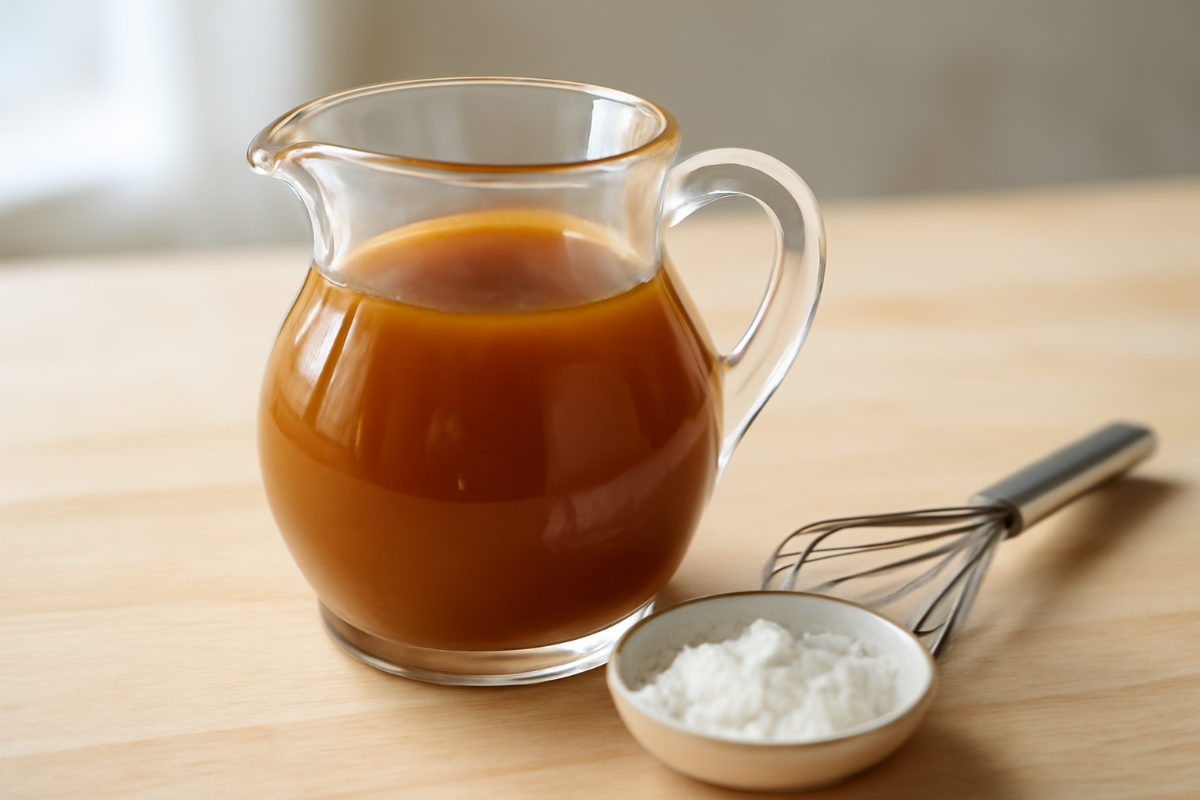
A turkey pan gravy thickened with cornflour at the end rather than a flour roux, so it stays glossy and nobody has to be handed a different jug.
- Contains meat
- Gluten free
- gluten free
- christmas
- turkey
- cornflour
- Prep
- 10 min
- Cook
- 25 min
- Total
- 35 min
- Serves
- 8
- Difficulty
- Easy
Cooking for a coeliac at Christmas is mostly about avoiding cross contamination rather than about clever substitutions. The gravy itself is easy: build the flavour exactly as you would, then thicken with cornflour at the end. It comes out shinier than a floury gravy, which is no bad thing. Just be careful about stock cubes and about which spoon has been in the stuffing.
Ingredients
Makes about 800ml, enough for eight plates
Scaled amounts are rounded to something you can actually measure. Season at the end and trust your mouth over the maths.
Kit
- Roasting tin
- Small bowl
- Whisk
- Fine sieve
Method
Before you start, get a clean pan, a clean whisk and a clean sieve. If the same sieve strained something with flour in it earlier, wash it properly. This is the part that actually matters for a coeliac, more than the ingredients.
Rest the turkey and pour the fat off the tin down to three tablespoons. If your stuffing contained breadcrumbs and was cooked in the bird or in the same tin, do not use this tin. Start the gravy in a clean pan with butter or oil instead and accept a little less depth.
Set the tin over a medium heat and cook the onion and carrot in the fat for eight minutes until soft and browning. Without a roux to carry flavour, these vegetables are doing more work than usual, so let them properly caramelise.
Pour in the wine and scrape the base of the tin hard while it bubbles. Let it reduce by half, about three minutes. Wine and spirits are naturally gluten free, so there is nothing to worry about here, but beer and most ales are not.
Add the stock and thyme, bring to a simmer and cook for twelve minutes so it reduces slightly and takes on the flavour of the vegetables. Cornflour thickens but it does not add flavour the way a cooked roux does, so this reduction is doing that job instead.
Strain into a clean pan and bring it back to a simmer. Whisk the slaked cornflour again, because it settles within a minute, then pour it into the moving gravy in a thin stream while whisking. It thickens almost immediately.
Simmer for one to two minutes only. Cornflour reaches full thickness fast and then starts to thin again if you boil it hard for long. Add the tamari, the resting juices and the vinegar, bring back to a simmer for a minute, then season and serve.
Tips worth knowing
- Always slake cornflour in cold water first. Tipped in dry it forms lumps that will not whisk out, unlike flour, which at least stands a chance.
- Cornflour thickened gravy thins if it is held hot for a long time. Make it close to serving, or hold it at 63C rather than at a simmer and be ready with a little extra slurry.
- Check the stock, the tamari and the mustard. Stock cubes are the usual hidden source of wheat, and standard Worcestershire sauce contains malt vinegar made from barley.
- Use arrowroot instead of cornflour if you want the clearest possible gravy. It sets slightly softer and does not go cloudy on reheating.
Change it up
- Swap the wine for an extra 150ml of stock and a tablespoon of cider vinegar, which keeps it gluten free and alcohol free at once.
- Add 100g of chopped cooked chestnuts and blitz them in for a naturally thickened gravy that needs less cornflour.
- Use a gluten free cider and a teaspoon of English mustard in place of the wine and tamari for a version that suits gammon.
Keeping and reheating
Keeps three days in the fridge, cooled fast in a shallow container. Cornflour gravies do not freeze as well as floury ones and often come out watery, so if you want to freeze it, freeze the unthickened stock base and add a fresh slurry when you reheat. Bring to a rolling boil before serving.
Questions people ask
Is gravy gluten free?
Not usually. Traditional gravy is thickened with wheat flour, and gravy granules and most stock cubes contain wheat too. A gravy made from pan juices and stock and thickened with cornflour is naturally gluten free, as long as the stock is.
How much cornflour do I need to thicken gravy?
About one level teaspoon per 200ml of liquid for a pouring gravy. Slake it in twice its volume of cold water, add it to simmering gravy in a stream while whisking, and give it a minute or two. If it is still thin, make another small slurry rather than adding dry powder.
Can I use the turkey roasting tin if the stuffing had breadcrumbs in it?
No, not for someone with coeliac disease. Stuffing cooked in the cavity or in the same tin transfers gluten into the drippings. Cook the stuffing separately in its own dish, or make the gravy in a clean pan and build flavour from roasted vegetables and stock instead.