Sawmill Gravy
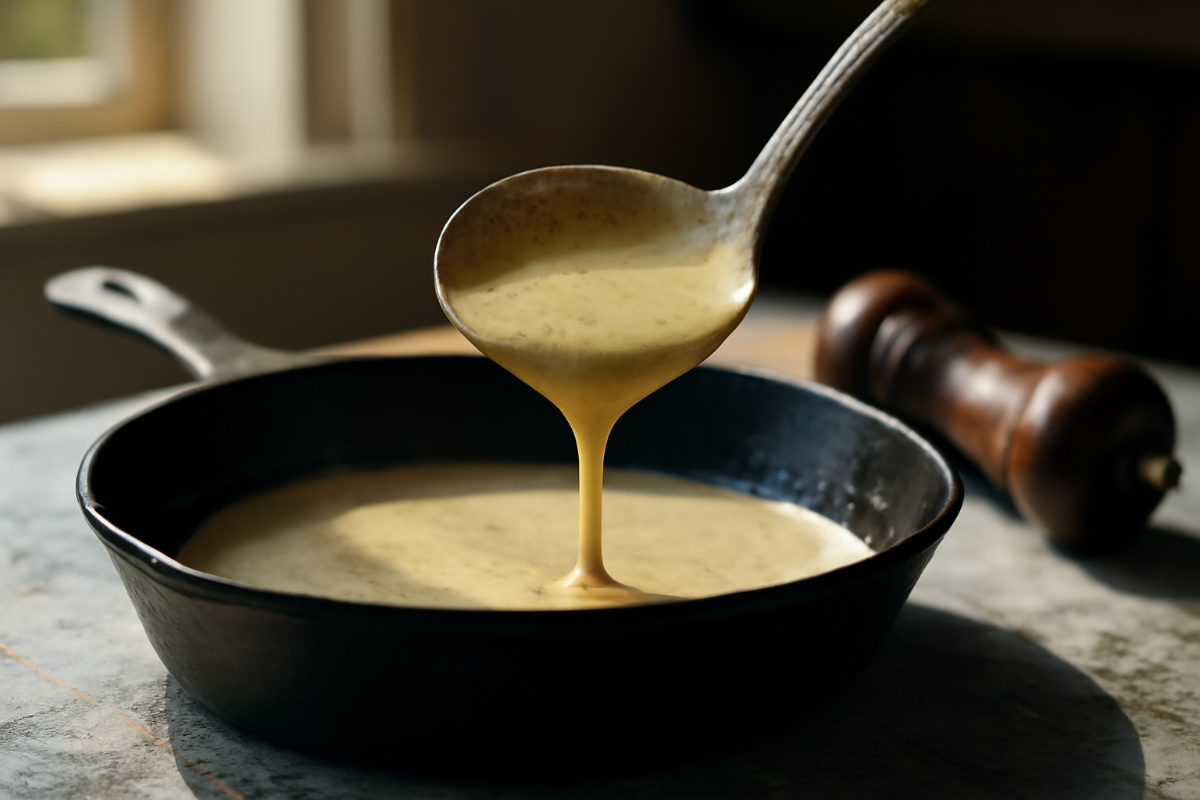
The older, rougher milk gravy, thickened with a mix of flour and coarse cornmeal so it has a slight grit, kept thin and hit with far more pepper than seems reasonable.
- Contains meat
- cornmeal
- historic
- breakfast
- peppery
- Prep
- 5 min
- Cook
- 18 min
- Total
- 23 min
- Serves
- 6
- Difficulty
- Easy
Sawmill gravy came out of logging camps and the story goes that the cornmeal in it looked like sawdust, hence the name. It is thinner than a modern sausage gravy and there is a faint grain to it from the cornmeal, which is the whole point rather than a fault. Made properly it is peppery enough to make you sit up.
Ingredients
Makes about 800ml, enough for six plates
Scaled amounts are rounded to something you can actually measure. Season at the end and trust your mouth over the maths.
Kit
- Heavy frying pan
- Wooden spoon
- Balloon whisk
Method
Put the sausage meat in a cold heavy frying pan, set it over a medium heat and break it up as it warms. Fry for eight minutes until well browned with plenty of rendered fat, then check you have about three tablespoons of fat in the pan and top up with dripping if not.
Mix the flour and cornmeal together in a cup first. They absorb liquid at different rates and combining them dry stops the cornmeal sitting in clumps.
Scatter the mixture over the meat and stir it through the fat. Cook for two to three minutes over a medium heat. The cornmeal will smell toasty and the whole thing will look like coarse wet sand.
Pour in about 200ml of the warm milk and stir hard. It will thicken sharply. Work out any clumps against the base of the pan with the back of the spoon.
Add the rest of the milk in two goes, whisking. It will look far too thin at this stage compared to a modern sausage gravy, which is exactly right, because cornmeal keeps swelling as it cooks.
Bring to a bare simmer and cook for eight to ten minutes, stirring every minute or so. The cornmeal needs this time to soften properly, and it will thicken the gravy noticeably in the last three minutes.
Add both peppers and taste for salt. Sawmill gravy is meant to be aggressively peppery, so if it tastes polite you have not put enough in. Serve loose and hot over split scones or fried potatoes.
Tips worth knowing
- Do not use instant or fine polenta. The coarse grind is what gives sawmill gravy its slight texture, and the fine sort just turns it pasty.
- Cornmeal thickens slowly and then all at once. Judge the consistency at the eight minute mark rather than at two minutes, or you will add milk you do not need.
- Keep it thinner than a modern sausage gravy. It is supposed to run across a plate, not sit on it in a mound.
- Grind the black pepper coarse. Fine pepper disappears into the milk and gives you heat without the flecks and the bite that define this gravy.
Change it up
- Leave the sausage out and use four tablespoons of bacon dripping for a meatless version that is closer to what the logging camps would actually have eaten.
- Stir in a chopped fresh green chilli with the pepper for a version from the hill country of Texas.
- Use half milk and half chicken stock for a lighter gravy that suits an evening plate of chops better than a breakfast one.
Keeping and reheating
Keeps three days in the fridge and sets very firm because of the cornmeal. Reheat with a generous splash of milk over a low heat, stirring until it loosens. Freezing makes the cornmeal grainy, so it is best avoided.
Questions people ask
What is the difference between sawmill gravy and sausage gravy?
Sawmill gravy is the older recipe and uses cornmeal, or a mix of cornmeal and flour, which gives a slightly grainy texture and a thinner pour. Modern sausage gravy uses only flour and is thicker and smoother. The seasoning in sawmill gravy is also usually much heavier on pepper.
Why is it called sawmill gravy?
The most repeated story is that the cornmeal in it resembled sawdust, and that it was fed to workers at logging camps and sawmills. Whether that is the true origin or a later invention is anyone's guess, but the cornmeal is definitely the reason for the name.
Can I use polenta instead of cornmeal?
Yes, coarse polenta and coarse cornmeal are essentially the same thing. Avoid quick cook or instant polenta, which is precooked and turns the gravy gluey rather than giving it the slight grain you are after.