Gravy from Bouillon Powder
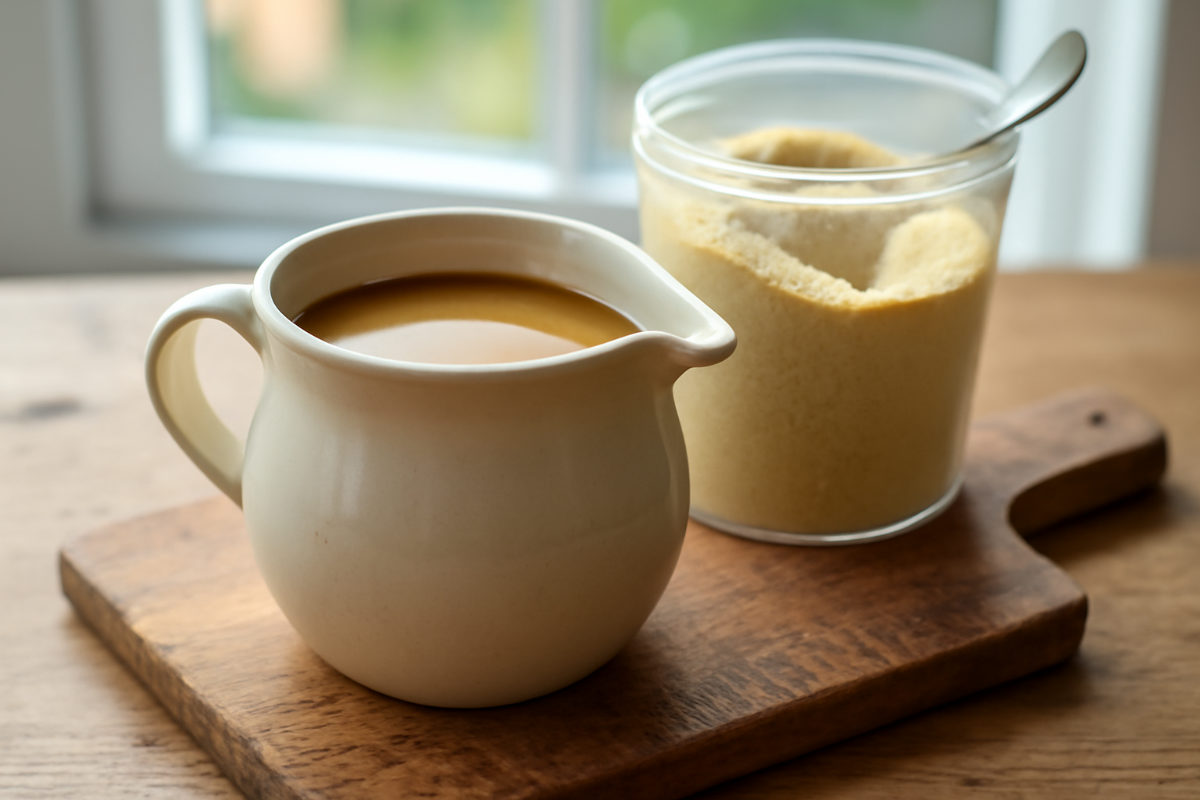
Bouillon powder lets you dial the strength up and down by the spoonful, which makes it the most controllable shortcut on the shelf if you know how to use it.
- Vegetarian
- bouillon
- vegetarian
- adjustable
- weeknight
- Prep
- 3 min
- Cook
- 9 min
- Total
- 12 min
- Serves
- 4
- Difficulty
- Easy
The advantage of powder over a cube is precision. You can add half a teaspoon at a time and taste as you go, which means you can build the savoury level to exactly where you want it rather than being stuck with whatever a whole cube gives you. Most bouillon is also lighter and less aggressively salty than a cube, so there is more room to season.
Ingredients
Makes about 450ml, enough for four plates
Scaled amounts are rounded to something you can actually measure. Season at the end and trust your mouth over the maths.
Kit
- Small saucepan
- Whisk
- Measuring spoons
- Kettle
Method
Melt the butter in a small saucepan over a medium heat, stir in the tomato puree and cook it for thirty seconds until it darkens and loses its raw smell.
Add the flour and stir to a paste. Cook it for a minute and a half, longer than you would for a beef gravy, because bouillon gives you a pale liquid and this is your chance to get some colour into the pan.
Whisk in a third of the hot water. Note that this is plain water at this stage, not stock. The whole point of powder is that you add the flavour afterwards, in stages, once you can taste what you have got.
Add the rest of the water, whisk smooth and bring it to a simmer. Let it cook for three minutes to thicken.
Now start adding the bouillon powder, one teaspoon at a time, whisking each in and tasting before you add the next. Two teaspoons is usually enough, three makes a strong gravy, and you may well stop at two and a half.
Simmer for a further two minutes once you are happy with the strength, which lets the powder dissolve completely and takes the powdery edge off.
Off the heat, add the vinegar and plenty of pepper. Because bouillon is generally less salty than a cube, this is one of the few quick gravies that might actually want a pinch of salt, so taste properly before deciding.
If it has thickened past what you want, whisk in hot water rather than more bouillon liquid, otherwise the seasoning creeps up without you noticing.
Tips worth knowing
- Add powder to the thickened gravy, not to the water at the start. Once flour and butter are in, the gravy tastes different, and seasoning after that point is the only way to get it right.
- Bouillon powders vary hugely in salt. A vegetable powder is usually fairly gentle, some catering powders are ferocious, so taste yours on a fingertip before you start.
- Powder clumps in hot liquid if you dump it in. Sprinkle it across the surface from a spoon while whisking.
- Keep the tub sealed and dry. Bouillon powder draws in moisture and turns into a solid brick in a damp cupboard, at which point it is very hard to measure accurately.
Change it up
- Use a chicken bouillon and finish with a squeeze of lemon and chopped tarragon for a light gravy that suits roast chicken or turkey.
- Add a teaspoon of mushroom ketchup or half a teaspoon of miso paste along with the second spoon of bouillon for more depth.
- Use olive oil in place of butter and a vegan bouillon to make it fully plant based, adding an extra half teaspoon of tomato puree for body.
Keeping and reheating
Four days in the fridge, three months in the freezer. It reheats very cleanly. If it tastes weak after freezing, which sometimes happens, a quarter teaspoon of fresh bouillon whisked in as it warms fixes it.
Questions people ask
Is bouillon powder better than stock cubes for gravy?
It is more controllable, because you can add it half a teaspoon at a time and taste as you go. Cubes are cheaper and often stronger. For gravy, where the seasoning is easy to overshoot, the ability to adjust is genuinely useful.
How much bouillon powder do I need for gravy?
Start at one teaspoon per 250ml and taste. Two to three teaspoons in 500ml is the usual range for a gravy, but brands differ enormously in strength and salt, so the tasting matters more than the number.
Can you use bouillon powder instead of stock in a recipe?
Yes, that is exactly what it is for. Dissolve it in hot water at the strength the tub suggests and use it as stock. For gravy specifically, it is better to add the powder to the finished sauce rather than making stock first, because you can season more accurately.