French Onion Style Gravy
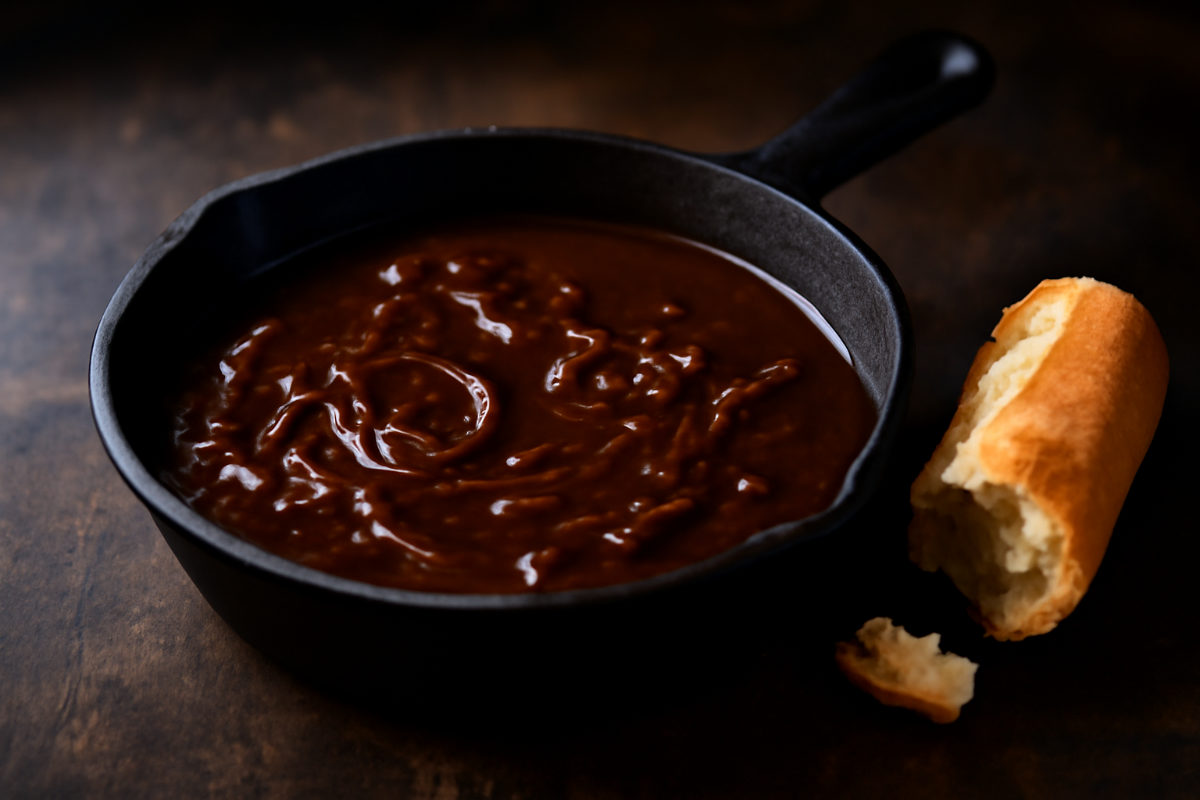
A kilo of onions taken to the far end of caramelisation over 45 minutes, deglazed with sherry, and turned into a gravy with all the depth of the soup.
- Contains meat
- french onion
- deep caramelisation
- sherry
- rich
- roast beef
- Prep
- 20 min
- Cook
- 1 hr 10 min
- Total
- 1 hr 30 min
- Serves
- 6
- Difficulty
- Medium
This is French onion soup wearing a different hat. The technique is identical, the onions go just as dark, and the sherry deglaze is doing the same job it does in a bowl. What changes is the ratio, because there is far less liquid, so everything the onions gave up stays concentrated. It is the richest gravy in this section and it needs a plain roast to sit against.
Ingredients
Makes about 600ml, enough for six plates
Scaled amounts are rounded to something you can actually measure. Season at the end and trust your mouth over the maths.
Kit
- Wide heavy based casserole
- Wooden spatula
- Whisk
Method
Melt the butter with the oil in a wide heavy casserole over a medium low heat. Add all the onions and the salt. They will look like far too many and fill the pan to the brim, which is normal, because they will cook down to about a fifth of that.
Cook for the first 15 minutes with the lid ajar, stirring every 5 minutes. The trapped steam softens them quickly and pulls out the water.
Take the lid off and carry on over a low to medium low heat for 30 to 40 minutes more, stirring every 3 or 4 minutes and scraping the base each time. The onions pass through pale gold at about 20 minutes, amber at 30, and a deep even brown at 40. Anyone who says this takes ten minutes has never done it.
Add the thyme and bay and cook for 2 minutes more. The pan base should be covered in a dark sticky glaze at this point.
Pour in the sherry and scrape hard while it bubbles and evaporates, which takes about a minute. The base will come clean and all that colour goes into the onions.
Stir in the flour and cook it for 2 minutes, then add the hot stock in three additions, whisking each one until smooth. Bring to a bare simmer.
Simmer very gently for 20 minutes, uncovered, stirring occasionally. It reduces, darkens further and turns properly glossy. Fish out the thyme stalks and bay, then season with black pepper and check the salt.
Tips worth knowing
- Use the widest pan you own. Surface area is what drives off moisture, and onions crowded into a narrow saucepan will steam for half an hour instead of browning.
- Salting at the start is deliberate. It draws water out fast, which shortens the soggy stage and gets you to browning sooner.
- If you want to hedge your bets, make this the day before. Deeply caramelised onions taste even better after a night in the fridge.
- For an alcohol free version, replace the sherry with 3 tablespoons of apple juice and a teaspoon of sherry vinegar and deglaze exactly the same way.
Change it up
- Finish each plate with a spoonful of the gravy and a slice of toasted baguette topped with grilled Gruyère, which is the soup sneaking back in.
- Use half beef and half chicken stock and add a splash of brandy instead of the sherry for a version that suits roast chicken.
Keeping and reheating
Fridge for 5 days, freezer for 4 months. This is the best keeper of the lot because the flavour is already so concentrated. Reheat slowly with a splash of stock.
Questions people ask
How long does it really take to caramelise onions?
For a kilo of onions in a wide pan, 40 to 50 minutes from raw to deep brown, and there is no honest shortcut. Higher heat gives you scorched edges and raw centres, and a pinch of bicarbonate of soda saves maybe ten minutes at the cost of texture.
Can I use white onions for French onion gravy?
Brown onions are the right choice because they have the balance of sugar and sulphur compounds that gives that classic deep flavour. White onions are milder and go sweeter, and red onions turn jammy rather than savoury. Any of them work, they just taste different.
Why are my onions burning instead of caramelising?
The heat is too high, the pan is too thin, or you are not stirring often enough. Caramelising happens between about 140 and 165C at the pan surface, and above that you get scorching. Drop the heat, add a splash of water when the base darkens, and scrape.