Worcestershire Sauce Gravy
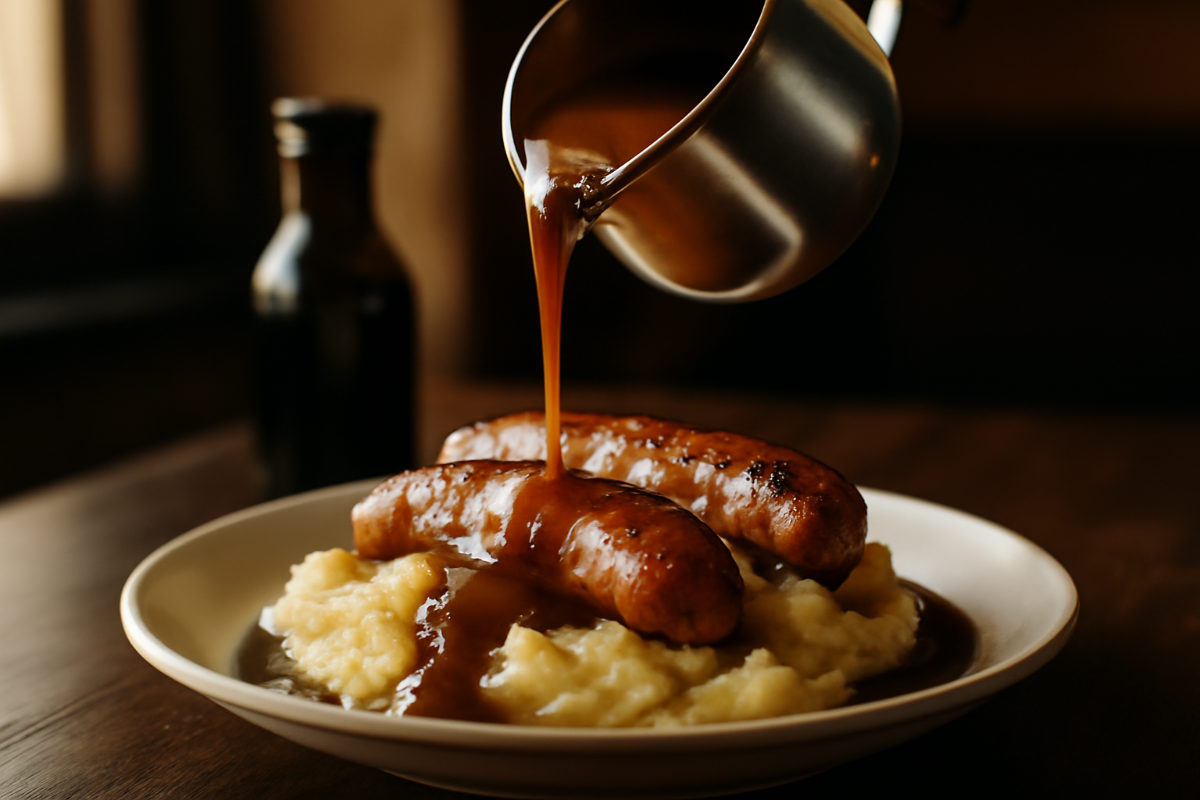
A straightforward beef gravy carried by a tablespoon of Worcestershire sauce, which brings tamarind, anchovy and malt vinegar in one bottle.
- Contains meat
- Contains fish
- worcestershire
- beef
- store cupboard
- quick
- Prep
- 5 min
- Cook
- 15 min
- Total
- 20 min
- Serves
- 4
- Difficulty
- Easy
Worcestershire sauce is already fermented anchovy, tamarind, molasses and malt vinegar, so a single tablespoon gives a gravy salt, acid, sweetness and savoury depth without you having to buy four things. It is the most useful bottle on the shelf for gravy. Serve it with roast beef, sausages, a cottage pie or over chips.
Ingredients
Makes about 450ml, enough for four plates
Scaled amounts are rounded to something you can actually measure. Season at the end and trust your mouth over the maths.
Kit
- Small saucepan
- Balloon whisk
- Measuring jug
Method
Melt the butter in a small saucepan over a medium heat. Add the onion and cook for six or seven minutes, stirring, until it is soft and just starting to take colour.
Tip in the flour all at once and stir to a paste. Cook for a full minute and a half, until it goes the colour of wet sand and smells biscuity rather than raw.
Add a quarter of the hot stock and whisk hard. It will seize into a thick lump. Keep whisking until it is completely smooth before adding any more.
Add the remaining stock in two goes, whisking between each, then bring the gravy to a gentle simmer.
Cook at a bare simmer for five minutes, whisking now and then, until it thickens enough to coat a spoon and hold a line when you drag a finger across the back of it.
Take it off the heat and stir in the Worcestershire sauce, the ketchup and the mustard if you are using it. Adding the Worcestershire off the heat keeps its sharpness, which is half of what it is there for.
Taste and season. It will already be fairly salty, so pepper first, salt last. If you want it sharper, another two teaspoons of Worcestershire is fine, but stop there.
Tips worth knowing
- One tablespoon per 550ml is the working measure, and about two tablespoons is the absolute maximum. Beyond that the malt vinegar takes over and the gravy tastes sour and thin.
- Add most of it off the heat. Long boiling drives off the vinegar sharpness and leaves only the sweetness behind, which is not the point of the bottle.
- Worcestershire sauce contains anchovies, so it is not vegetarian. Henderson's Relish is the usual swap, similar in spirit and made without fish.
- It also contains malt vinegar from barley, so this gravy is not gluten free even before you count the flour.
Change it up
- Use Henderson's Relish instead of Worcestershire and vegetable stock, with a plant butter, for a version that is vegetarian and, if you check the relish label, close to vegan.
- Add 100ml of stout with the first of the stock for a deeper, more bitter gravy that suits a cottage pie.
- Stir in a teaspoon of Marmite along with the Worcestershire for a much heavier, saltier gravy, and hold back on any extra salt.
Keeping and reheating
Keeps four days in the fridge and freezes for three months. It loses a little of its sharp edge in the freezer, so add a teaspoon of fresh Worcestershire when you reheat it.
Questions people ask
How much Worcestershire sauce should I put in gravy?
One tablespoon per 550ml is the sensible measure, added off the heat at the end. Two tablespoons is the upper limit, after which the malt vinegar dominates and the gravy turns sour.
Is Worcestershire sauce vegetarian?
The classic version is not, because it is fermented with anchovies. It also contains barley malt vinegar so it is not gluten free. Henderson's Relish is the traditional Sheffield alternative and contains no fish, which makes it the usual swap for vegetarians.
What does Worcestershire sauce do in gravy?
It supplies four things at once: salt, malt vinegar acidity, molasses sweetness and the savoury depth that comes from fermented anchovy and tamarind. That is why a tablespoon can rescue a gravy made with nothing but a stock cube.