Sweet White Onion Gravy
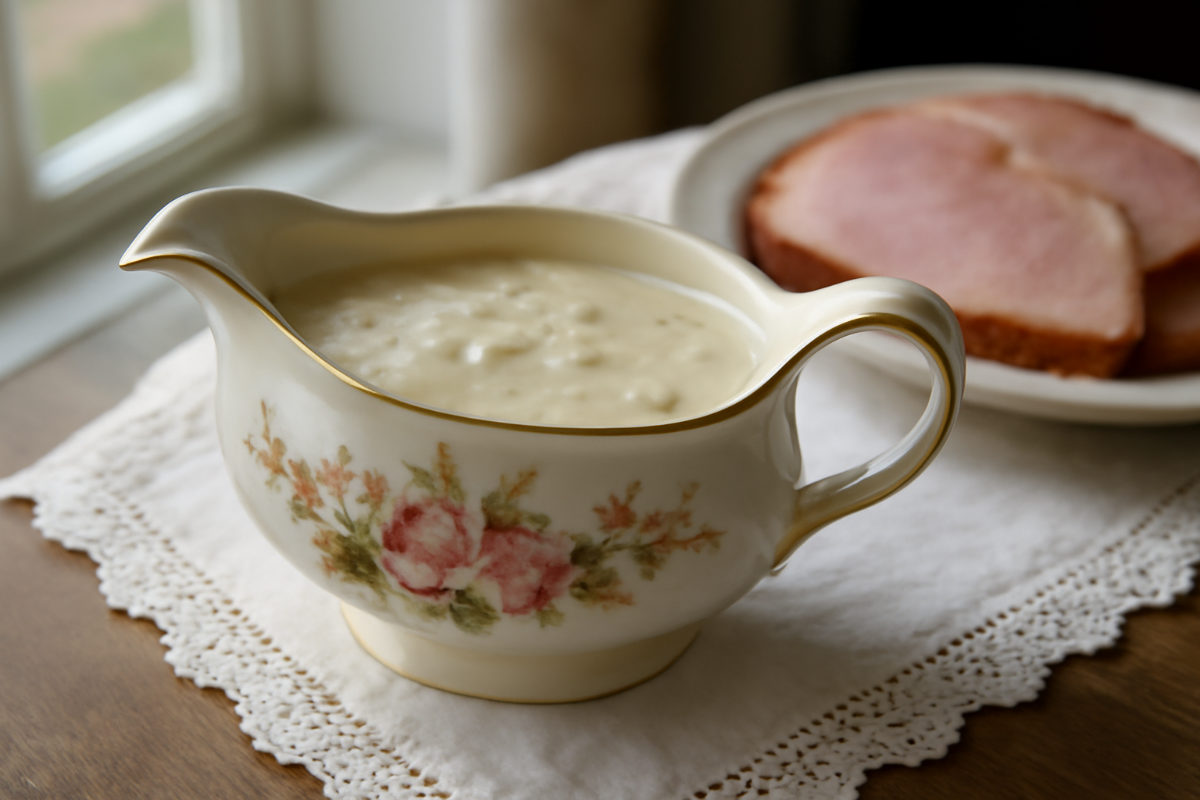
White onions sweated under a lid with no colour at all, built into a blond roux gravy that stays pale, sweet and gentle.
- Contains meat
- white onion
- pale gravy
- gammon
- pork
- no browning
- Prep
- 10 min
- Cook
- 40 min
- Total
- 50 min
- Serves
- 4
- Difficulty
- Easy
Not every onion gravy needs to be dark. Sweat white onions slowly under a lid and they go almost meltingly sweet without ever browning, and the result is a pale, mild gravy that suits things a heavy brown gravy would bully. Gammon, pork chops, roast chicken, a plate of boiled bacon and cabbage. It is an old fashioned thing and it deserves a comeback.
Ingredients
Makes about 450ml, enough for four plates
Scaled amounts are rounded to something you can actually measure. Season at the end and trust your mouth over the maths.
Kit
- Saucepan with a lid
- Whisk
- Baking parchment
Method
Melt the butter in a saucepan over a low heat and add the onions with a good pinch of salt. Cut a circle of baking parchment to fit inside the pan and press it down onto the onions, then put the lid on top.
Sweat them for 30 minutes over the lowest heat your hob will hold, lifting the lid to stir every 10 minutes. The parchment traps the steam and keeps the onions wet, so they never get hot enough to brown. They should end up almost translucent and falling apart.
Take off the parchment. If there is a lot of liquid in the pan, turn the heat up for a minute or two to drive it off, but stop the moment the onions start to colour.
Stir in the flour and cook it over a low heat for 2 minutes without letting it take any colour. You want a blond roux, so keep it moving and keep the heat down.
Add the hot stock a third at a time, whisking hard between each addition until smooth, then add the bay leaf. Bring to a gentle simmer.
Simmer for 8 to 10 minutes, stirring now and then, until it is the thickness of single cream and tastes of onion rather than flour. Fish out the bay leaf.
Stir in the cider vinegar to stop it being cloying, then season with salt and white pepper. It should be pale ivory with flecks of soft onion running through it.
Tips worth knowing
- White onions are milder and sweeter than brown. If you can only get brown ones, sweat them five minutes longer and add a pinch of sugar.
- The parchment circle is not a fussy detail. Without it the onions dry out and start to brown before they are properly soft.
- This gravy is very good stirred into the water gammon was boiled in, though taste first because ham stock can be brutally salty.
- A grating of nutmeg over the finished gravy takes it towards an old fashioned onion sauce, which is no bad thing.
Change it up
- Replace 150ml of the stock with whole milk for something between an onion gravy and a proper onion sauce, ideal with roast mutton.
- Add a teaspoon of English mustard powder with the flour for a sharper version that stands up to a thick gammon steak.
Keeping and reheating
Fridge for 3 days. It sets firm when cold because of the roux, so reheat gently with a good splash of stock or milk and whisk it smooth. Freezes for 2 months.
Questions people ask
What is the difference between onion gravy and onion sauce?
Onion sauce is milk based, closer to a white sauce with onions in, and traditionally served with mutton. Onion gravy is stock based. This recipe sits between the two, which is why the milk variation works so easily.
Can I make onion gravy without browning the onions?
Yes, and this is that recipe. You lose the deep savoury notes that caramelisation gives you, but you gain a clean, sweet onion flavour that suits pork and poultry. Sweating under a lid is the technique that gets you there.
Why does my pale gravy taste floury?
The roux was not cooked long enough, or the gravy was not simmered long enough after the stock went in. Give the flour two full minutes in the butter and then at least eight minutes of simmering, and the raw taste disappears.