Rolled Turkey Breast Gravy
A smaller scale turkey gravy for a boned and rolled breast, thickened at the end with beurre manie so you can judge the consistency exactly.
- Contains meat
- turkey
- turkey breast
- small christmas
- beurre manie
- Prep
- 10 min
- Cook
- 25 min
- Total
- 35 min
- Serves
- 5
- Difficulty
- Medium
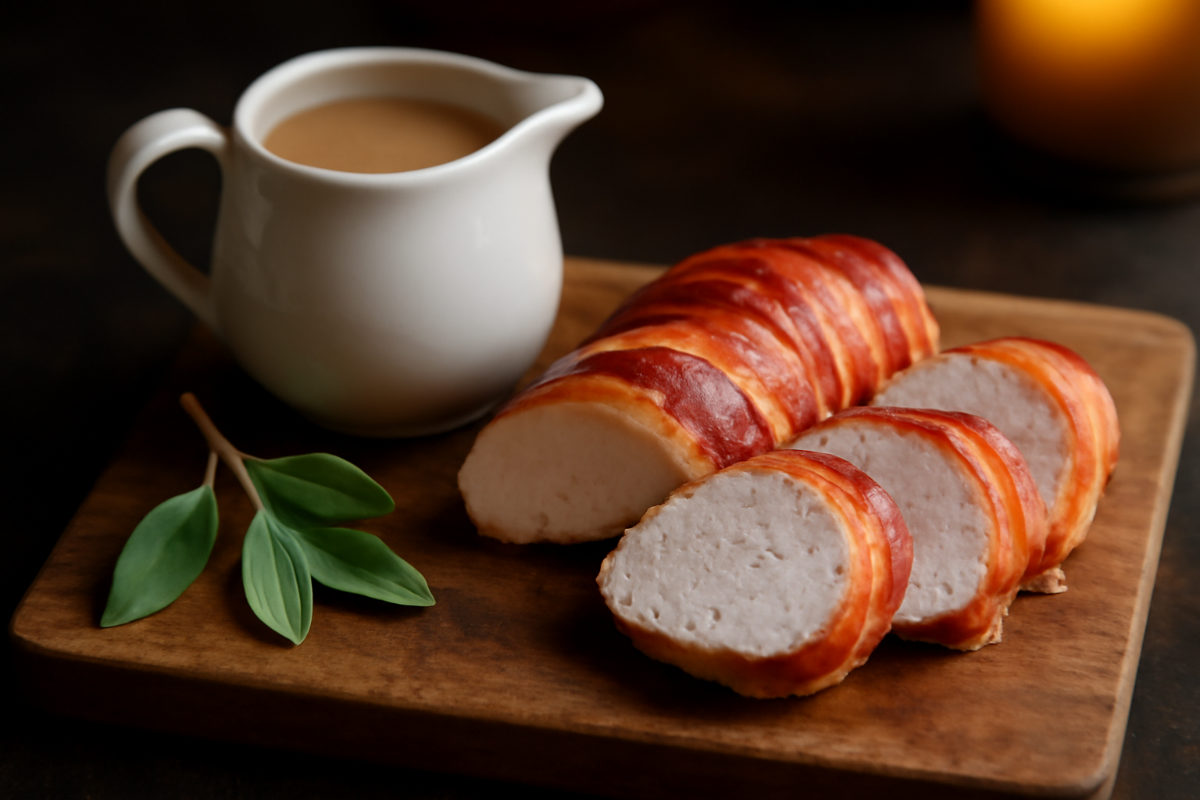
A rolled turkey breast has no carcass, no giblets and very little fat, so the classic giblet gravy method does not apply. Instead you build a quick stock from the trimmings and bacon, then thicken at the end with butter and flour worked together, which lets you stop the moment it is right. It suits a small Christmas or a Sunday for four.
Ingredients
Makes about 500ml, enough for five plates
Scaled amounts are rounded to something you can actually measure. Season at the end and trust your mouth over the maths.
Kit
- Roasting tin
- Small bowl
- Whisk
- Sieve
Method
Roast the rolled breast on a bed of the chopped onion and carrot with the bacon laid over the top. That bed is your entire flavour base, since a boned joint leaves very little residue on its own.
When the joint is out and resting, wrapped in foil for twenty minutes, put the tin on the hob over a medium heat and let the vegetables and bacon fry in the fat for four or five minutes so they take on more colour.
Pour in the wine and boil for three minutes, scraping the base hard. Add the stock, bring to a simmer and cook for twelve minutes so the vegetables and bacon give everything up.
Strain into a clean saucepan, pressing the vegetables firmly. You should have about 550ml of savoury, unthickened liquid. Taste it now, and if it is weak, boil it down for another five minutes before thickening.
Mash the soft butter and the flour together in a small bowl with a fork until you have a smooth yellow paste with no dry specks. This is beurre manie and it is the most forgiving way to thicken a sauce.
Bring the strained liquid to a simmer and drop in the paste a pea sized piece at a time, whisking each one in fully before the next. Watch the consistency and stop as soon as it coats the back of a spoon, which usually takes about three quarters of the paste.
Simmer for four minutes more so the flour cooks out properly. Uncooked beurre manie tastes pasty, and this short simmer is not optional.
Stir in the cranberry sauce and the resting juices from the foil, then season. Serve it slightly thinner than you would a beef gravy, as turkey breast is dry and needs the moisture.
Tips worth knowing
- Beurre manie is the right tool when you cannot judge the liquid in advance. Add it gradually and you can hit the exact thickness rather than guessing at the roux stage.
- Ask the butcher for the bones if the breast has been boned for you. Twenty minutes in the stock transforms it.
- The bacon is doing double duty, keeping the lean breast moist and giving the gravy fat and savour. Do not skip it.
- A rolled joint with stuffing inside will leak seasoned juices into the tin. Taste before salting, because stuffing carries a lot of salt.
Change it up
- Add a tablespoon of chopped sage and a spoon of grain mustard for a version that goes with sage and onion stuffing.
- Use 100ml apple juice with a teaspoon of cider vinegar in place of the wine for a non-alcoholic version.
- Stir in 50ml double cream at the end for a richer gravy that suits a plain unstuffed breast.
Keeping and reheating
Keeps four days in the fridge and freezes for three months. Butter thickened gravies reheat well, just do it slowly and whisk as it comes back to a simmer.
Questions people ask
What is beurre manie and why use it for gravy?
It is equal weights of soft butter and raw flour mashed to a paste, whisked into hot liquid at the end of cooking. Unlike a roux it lets you thicken by degrees, which is useful when you do not know exactly how much liquid you will end up with.
How is turkey breast gravy different from whole turkey gravy?
There are no giblets, no carcass and far less fat, so the flavour has to come from a bed of vegetables, bacon and a decent stock instead of from the bird itself. The quantities are smaller too.
Can I make this without wine?
Yes. Use extra stock and a teaspoon of white wine vinegar, or apple juice with a splash of vinegar. The point of the wine is acidity to cut through a rich plate, so replace that rather than just leaving it out.